The Sudoku
was / cut.
Reassemble it.
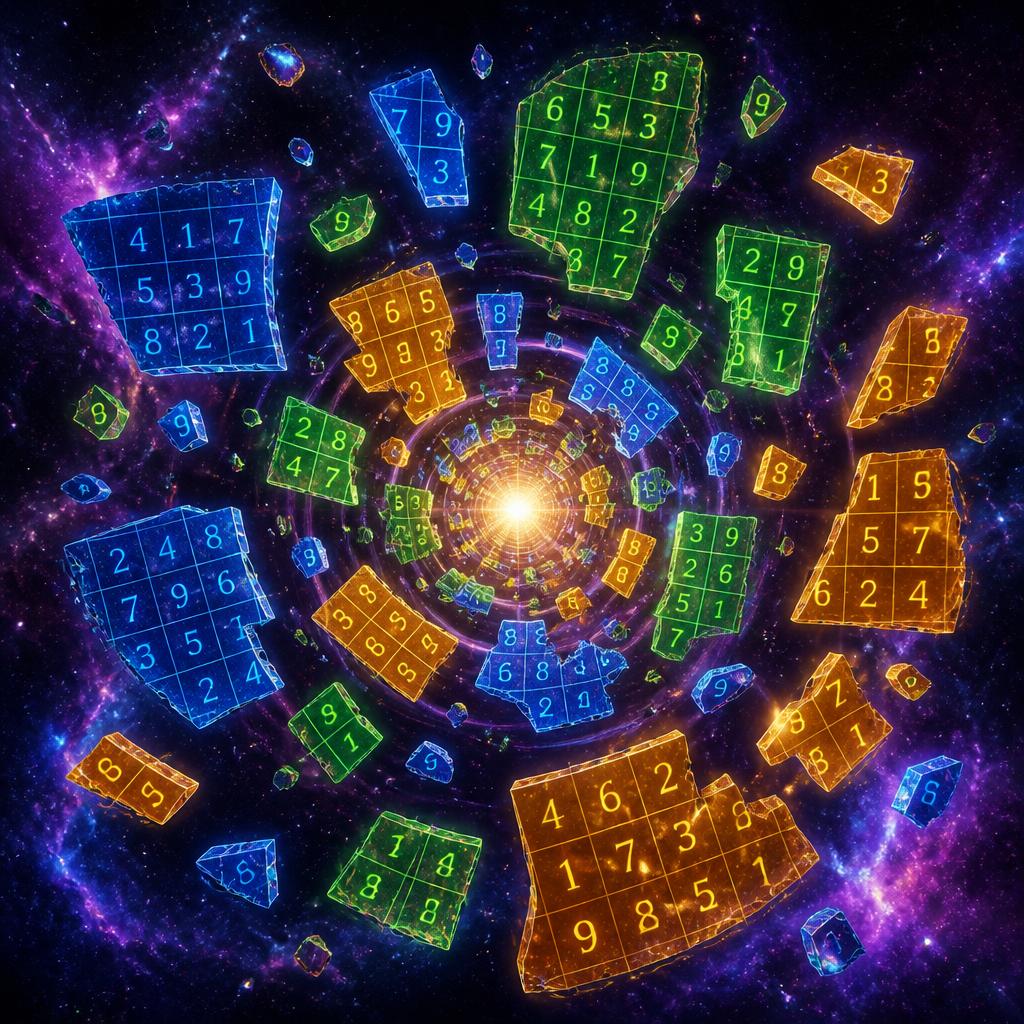
A completed 9×9 Sudoku has been sliced into shaped pieces. Put it back together using number logic alone — no picture, no edge matching. Pure deduction.
How SudoCut works
Three steps. Five seconds to understand. Hours to master.
Start with a completed Sudoku
Every row, column and 3×3 box contains each digit 1–9 exactly once. This is the solution — and also the puzzle.
We slice it into shaped pieces
The completed grid is cut into puzzle pieces of different shapes and sizes. You receive the pieces — not the picture of where they go.
Put it back using only numbers
No picture. No edge shapes to match. Only Sudoku logic tells you where each piece belongs. That’s the entire game.
Try it now →Numbers are your only clue
Each piece shows its numbers from the original Sudoku. Use row, column and box logic to figure out where in the grid it must go.
Drag or tap to place
Drag a piece onto the grid (desktop) or tap to select then tap to place (mobile). On medium and hard, rotate pieces with ↻ before placing.
Red means conflict
Cells turn red when a number repeats in a row, column or 3×3 box. Conflicts must be resolved — you can’t win with any red on the board.
All pieces placed = solved
Place every piece with no conflicts remaining. Use Hint to auto-place one piece if stuck, or Undo to walk back a mistake.
Three difficulty levels — three modes
Start gentle, go devilish. Each tier changes piece shape and size. Each mode changes how much help you get.
Rectangles only
Larger, rectangular pieces with no rotation required. The perfect entry point for learning how number logic guides placement.
Rotation: none
Best for: first-timers
L-shapes & T-shapes
Irregular pieces that can be rotated. A tighter logical grip required — the shape no longer narrows the search as much.
Rotation: yes
Best for: puzzle veterans
Arbitrary polyominoes
Small, oddly shaped pieces with no rotation hints. Pure deduction from start to finish — no shortcuts.
Rotation: yes
Best for: masochists
Three modes
Pieces in order, top-left first
The tray is sorted by position — top-left piece first, bottom-right last. Removes the search element so you can focus on understanding the number logic.
One anchor piece pre-placed
The top-left corner piece starts on the board. Use it as a reference — ideal for first-timers or anyone who wants a foot in the door before the logic takes over.
Empty grid — pure deduction
No anchor, no hints. Every piece is in the tray and the board is blank. You decide what goes where from the very first move. The intended SudoCut experience.
Shape gives you constraints. Numbers give you logic.
Unlike a jigsaw puzzle, there is no picture to guide you. Unlike classic Sudoku, you do not know where each piece belongs on the board. SudoCut sits at the intersection of both — a new puzzle that rewards pure deductive thinking.
Ready to make the first cut?
Free to play in your browser — desktop and mobile. No account, no install, no ads.
Start a puzzle →Got a thought? We want to hear it.
SudoCut is new. Your feedback shapes what it becomes — harder puzzles, new mechanics, daily challenges.